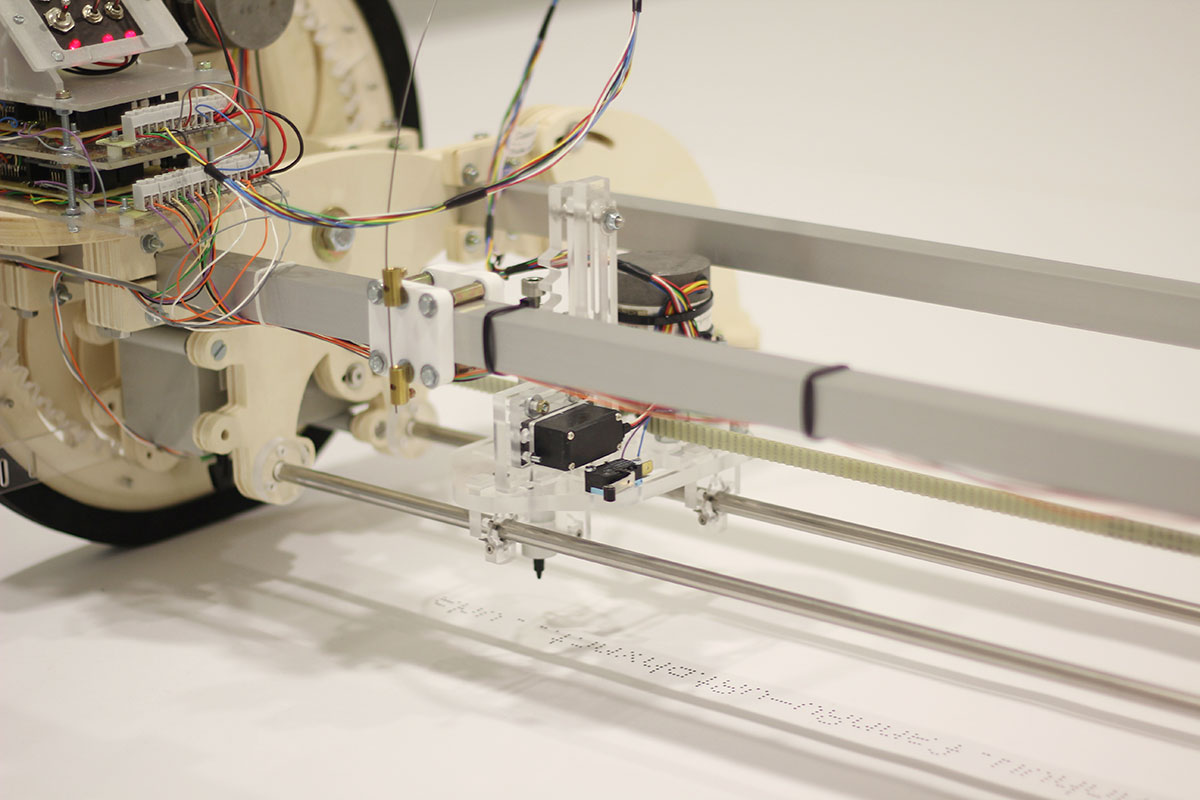
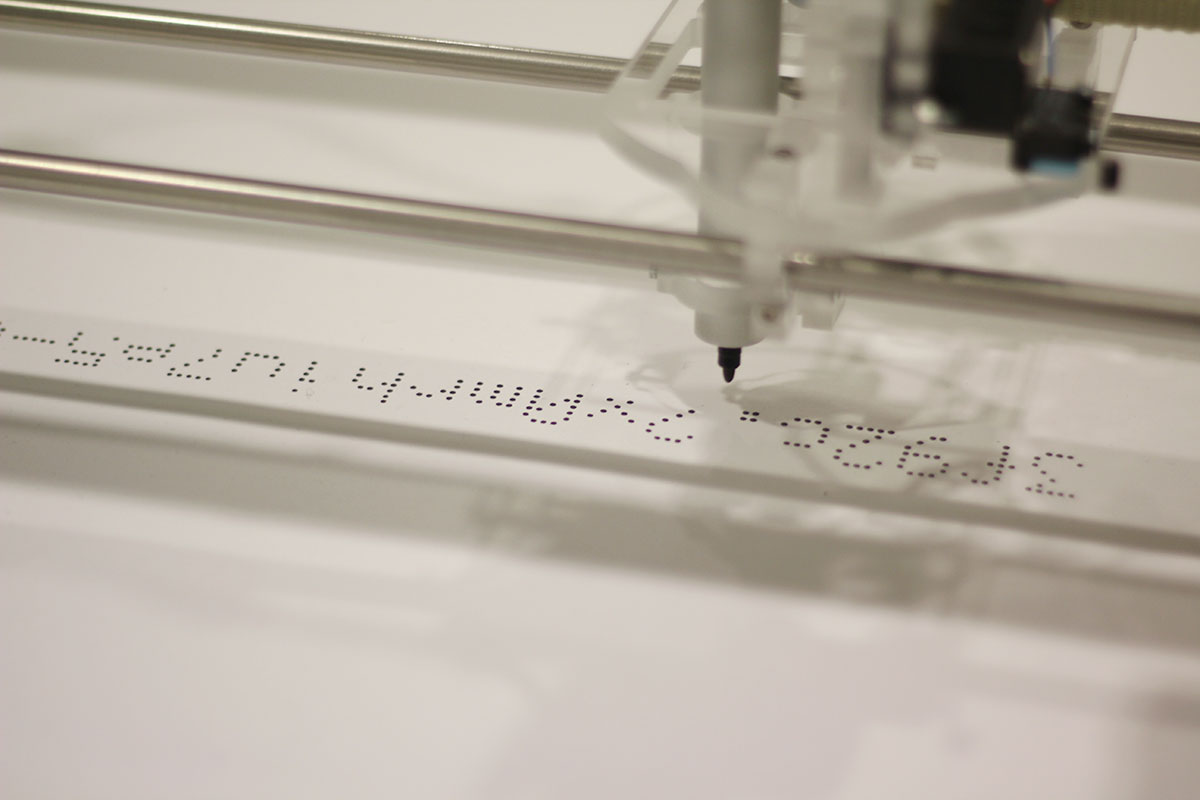
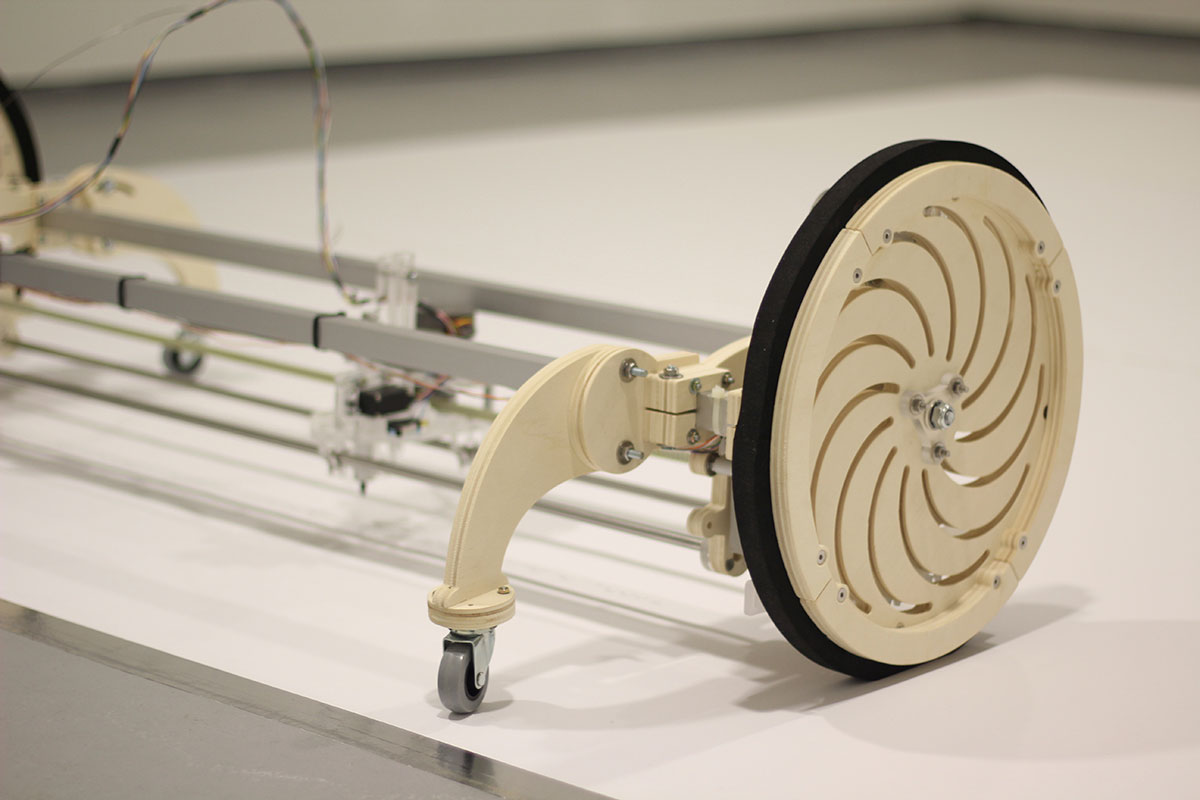
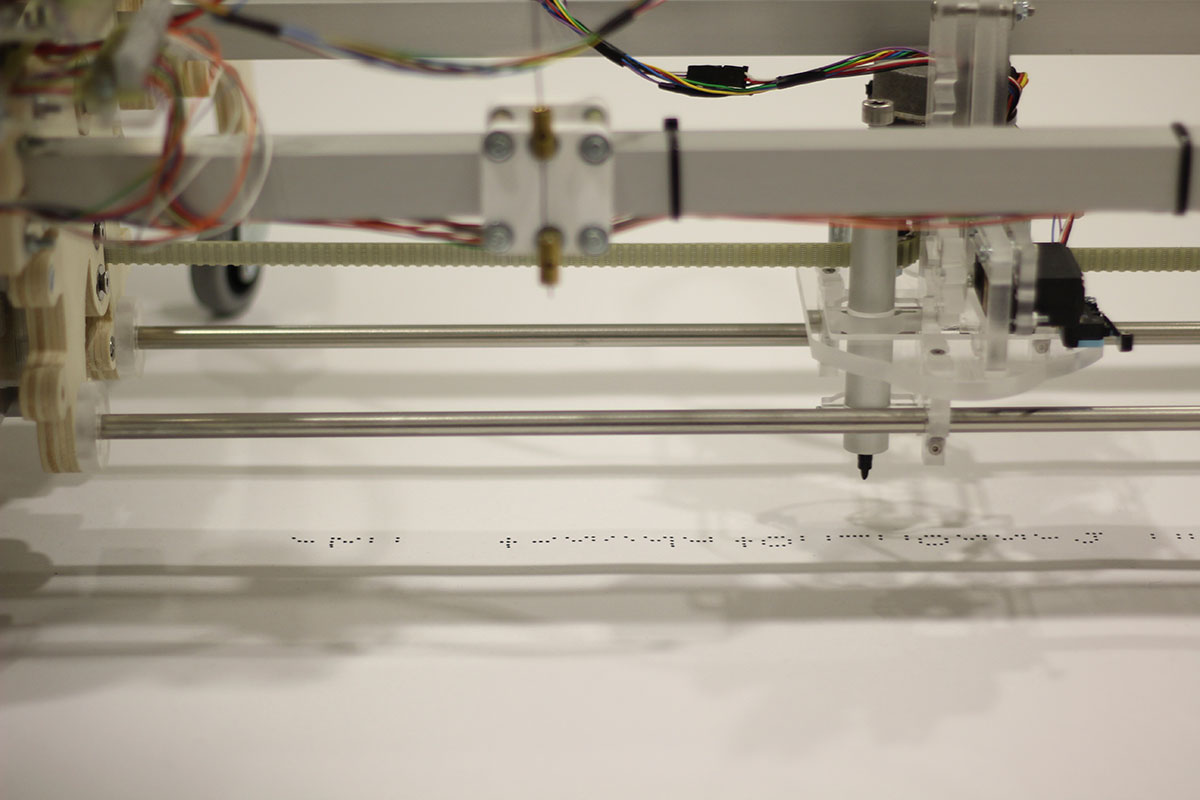
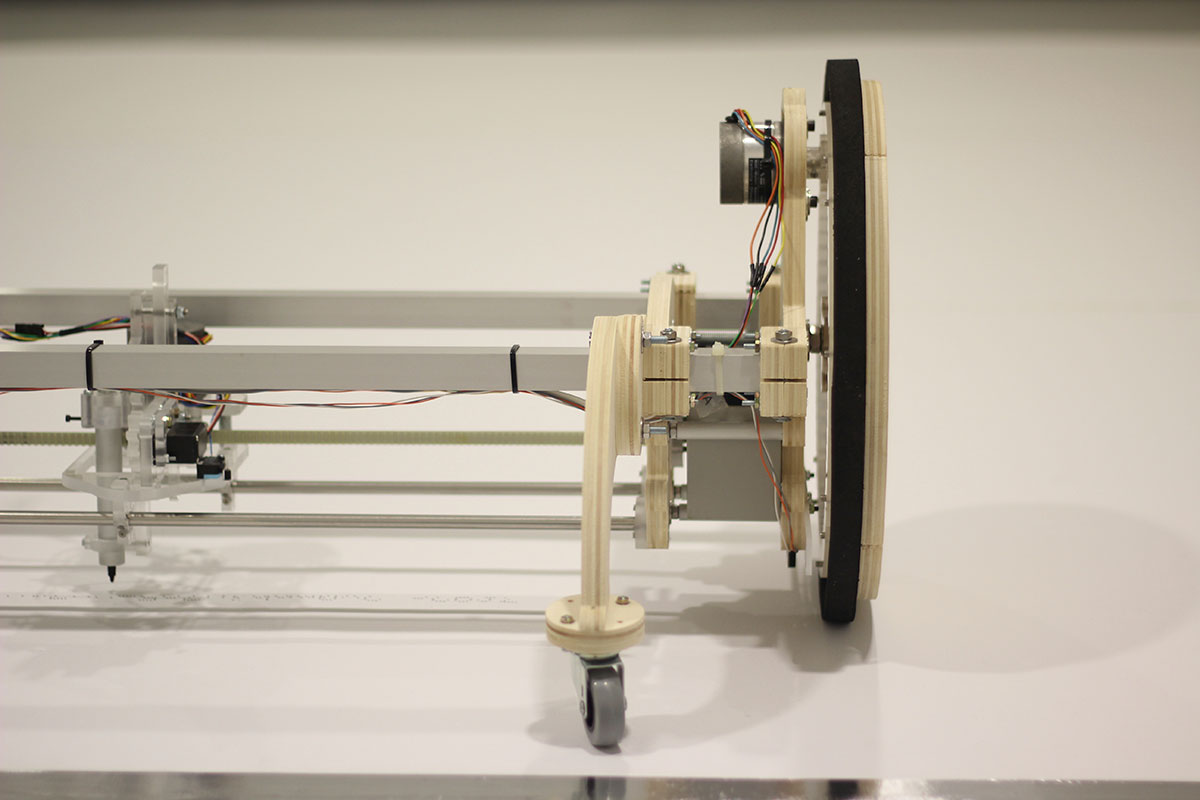
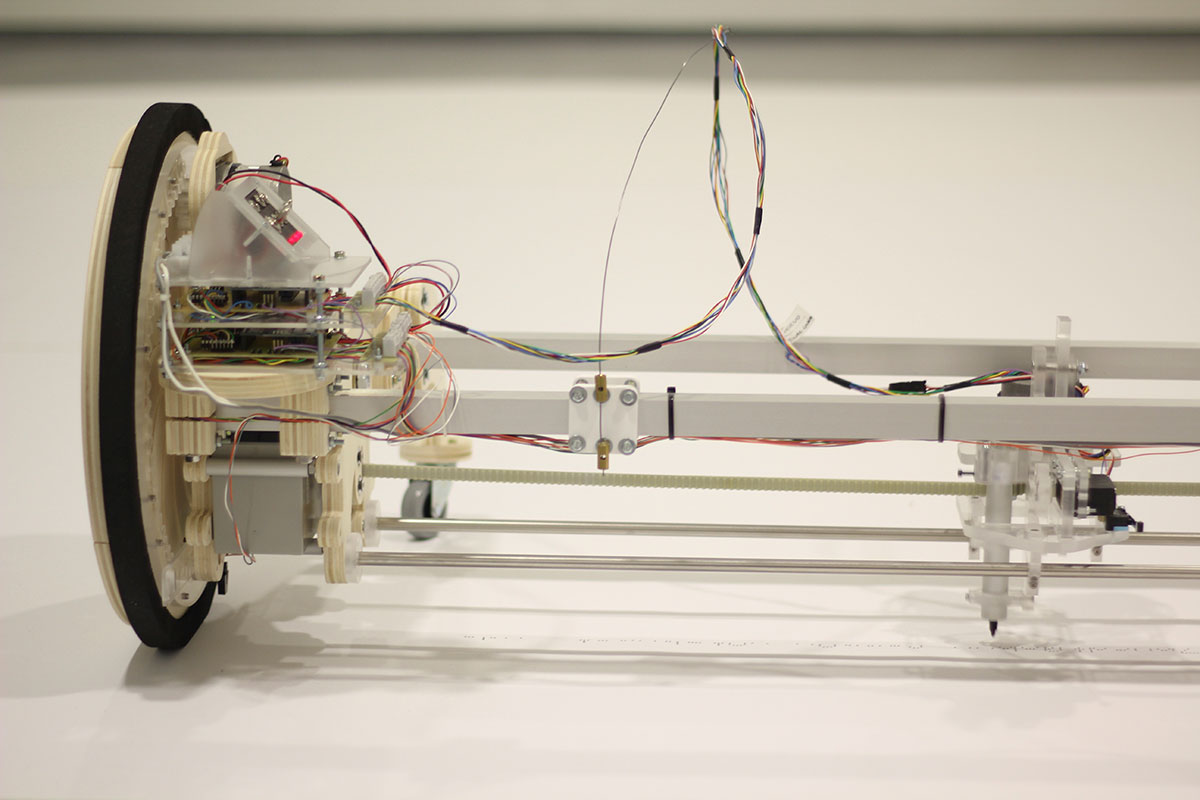
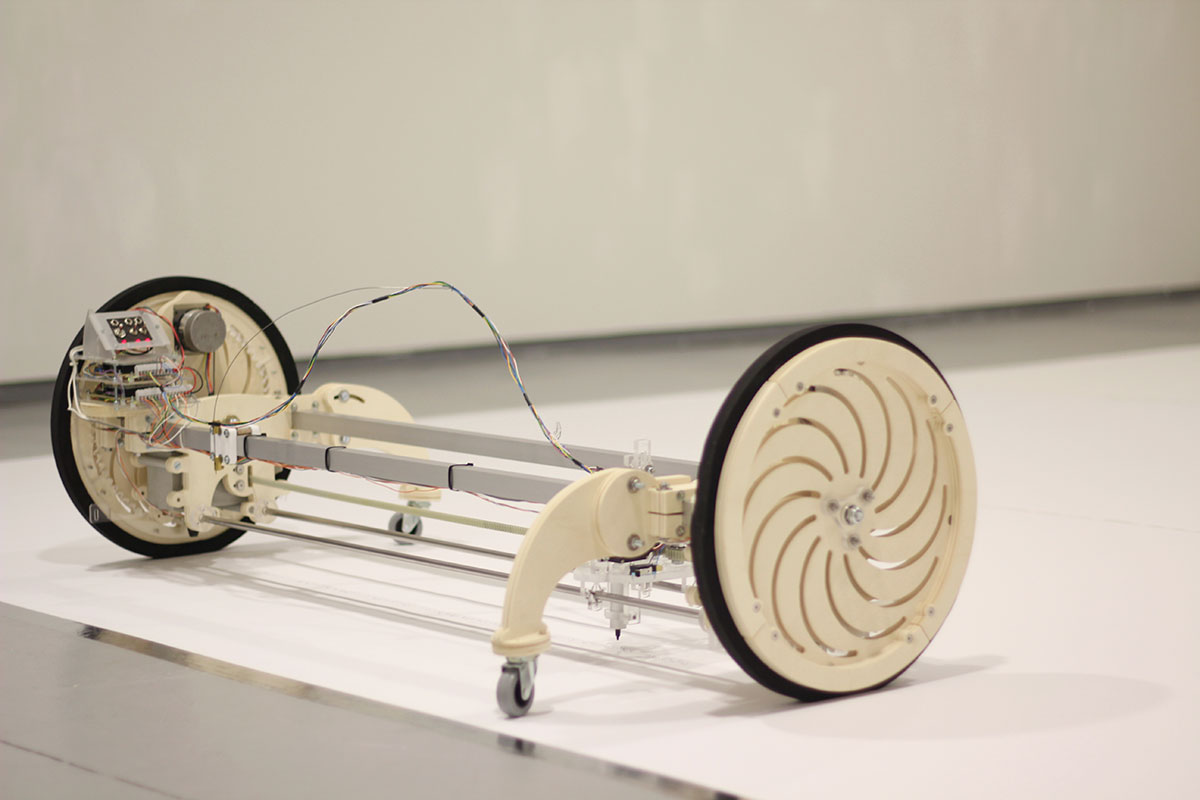
A robotic printer writes continuously across a large sheet of paper, confronting the impossibility of materialising every possible combination of language.
The Library of Babel takes as its starting point Jorge Luis Borges’s story of the same name and its description of a library containing every possible book: all the combinations that can be produced from a limited number of characters and, with them, everything that can be expressed through language.
The work translates this idea into a robotic writing system. A mobile printer moves autonomously across a large surface of paper laid out in the exhibition space, continuously printing randomly generated sentences. In this way, the device attempts to materialise a potentially infinite task through a machine and a medium that are necessarily finite.
As it moves, the printer gradually fills the paper with new combinations of characters, constructing an archive that grows throughout the operation of the installation. Writing ceases to respond to an author’s intention and instead becomes the result of an algorithmic process involving combinatorics, chance, and the behaviour of the machine itself.
The installation thus establishes a tension between the human capacity to imagine virtually unlimited systems and the material constraints that emerge when attempting to realise them. In contrast to the conceptual vastness of Borges’s library, the machine can only traverse a finite surface, operate for a finite amount of time, and produce a limited quantity of text.
EXHIBITIONS
Almagráfica. Feria de Arte. Oviedo (ES). 2017.
Process. Centro Municipal de Arte y Exposiciones (CMAE), Avilés (ES). 2015.
La Biblioteca de Babel. XI Generación AlNorte. Galería Espacio Líquido, Gijón (ES). 2012.
Desenho na Universidade Hoje. Faculdade de Belas Artes da Universidade do Porto, Porto (PT). 2012.
PUBLICATIONS
Castellanos, M., & Valverde, A. “La Biblioteca de Babel / The Library of Babel”. In Drawing in the University Today. Faculdade de Belas Artes da Universidade do Porto, p. 497.