Work

Plants Also Look at the Stars

2019
← All works Work

"We envision an interspecies garden where plants, animals, and humans coexist with cyborg robotic systems controlled by plant organisms."

CONCEPTUALIZATION | PRODUCTION | TECHNOLOGY
María Castellanos & Alberto Valverde
Artistic assistance in the studio
Teresa Búa
WITH THE COLLABORATION OF
Daniel Romero, Paula López Barba, LABoral Centro de Arte y Creación Industrial, itdUPM (UPM), Rafael Ruiz López de la Cova, Luis Tejero (Departamento de Cambio Climático, D.G. de Sostenibilidad y Control Ambiental, Área de Medio Ambiente y Movilidad, Ayuntamiento de Madrid), Anna Pons (Fundación Biodiversidad), Ernesto Rodríguez (Jefe del Área de Modelización y Evaluación del Clima, AEMET), Eva Miedes, Santiago Moreno (Producción vegetal, ETSI Agronómica, Alimentación y Biosistemas, UPM), Chiquinquira Hontaria (Calidad de suelos, ETSI Agronómica, Alimentación y Biosistemas, UPM)
Funding
Project developed by invitation of Matadero Madrid, within the framework of Matadero Acción Mutante.
The Plants Also Look to the Stars emerges in the context of A Cyborg Garden for Matadero Madrid, an initiative that seeks to rethink Matadero’s outdoor space as a more habitable environment in response to the extreme conditions caused by the urban heat island effect. The site, with large areas lacking vegetation and shade, has become particularly vulnerable to rising temperatures in the city of Madrid.

In response to this situation, we were invited to develop a proposal that explores new forms of coexistence between human and non-human beings, incorporating knowledge from different disciplines and the potential of technology to imagine new models of relationship with the environment.

Building on our previous research, our proposal took the form of an interactive garden in which plants act as active agents within the system. Through sensors based on plant electrophysiology, we measure the electrical vibrations that occur within plants and make visible their biochemical responses to human presence, other living beings, and environmental conditions.

The information gathered from the plants is processed and translated into vibrations, movements, and sound, generating an interspecies system that allows us to perceive plant behavior and approach their language. The aim is to make accessible signals that normally lie beyond our perceptual capacity, expanding human sensory experience through robotic systems.

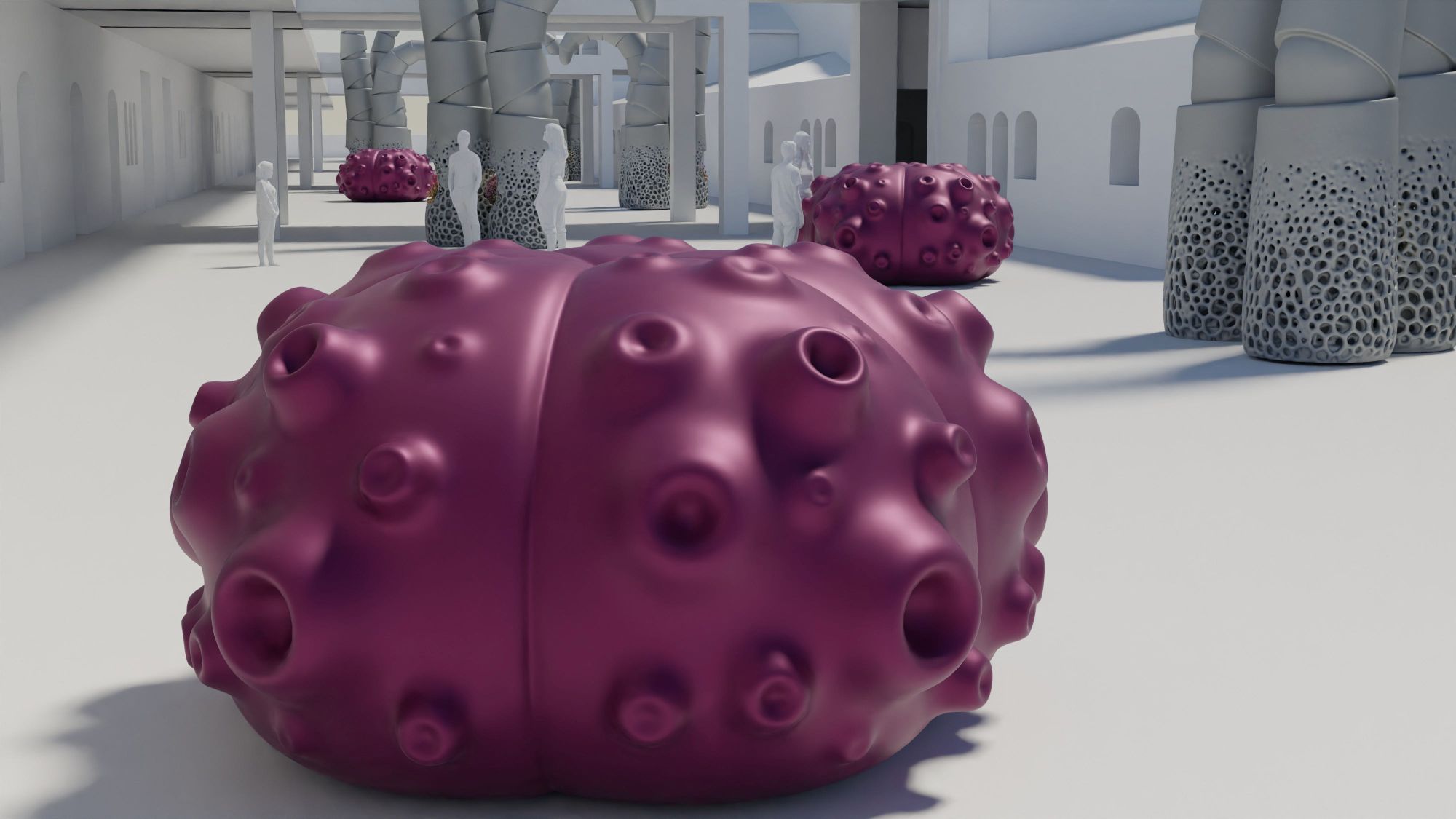
The project materializes in a series of large-scale sculptures with an organic appearance, designed both for the well-being of plants and other living beings inhabiting the Matadero space, and for the use and enjoyment of people. These structures create areas of shade, rest, and encounter, configuring a space of coexistence between species in which technological systems are directly connected to plant organisms.

At the same time, we developed soft interfaces that allow for a direct experience of plants. Through touch, vibration, and movement, these interfaces translate plant activity in real time, enabling a close, embodied experience of their behavior.
Stars

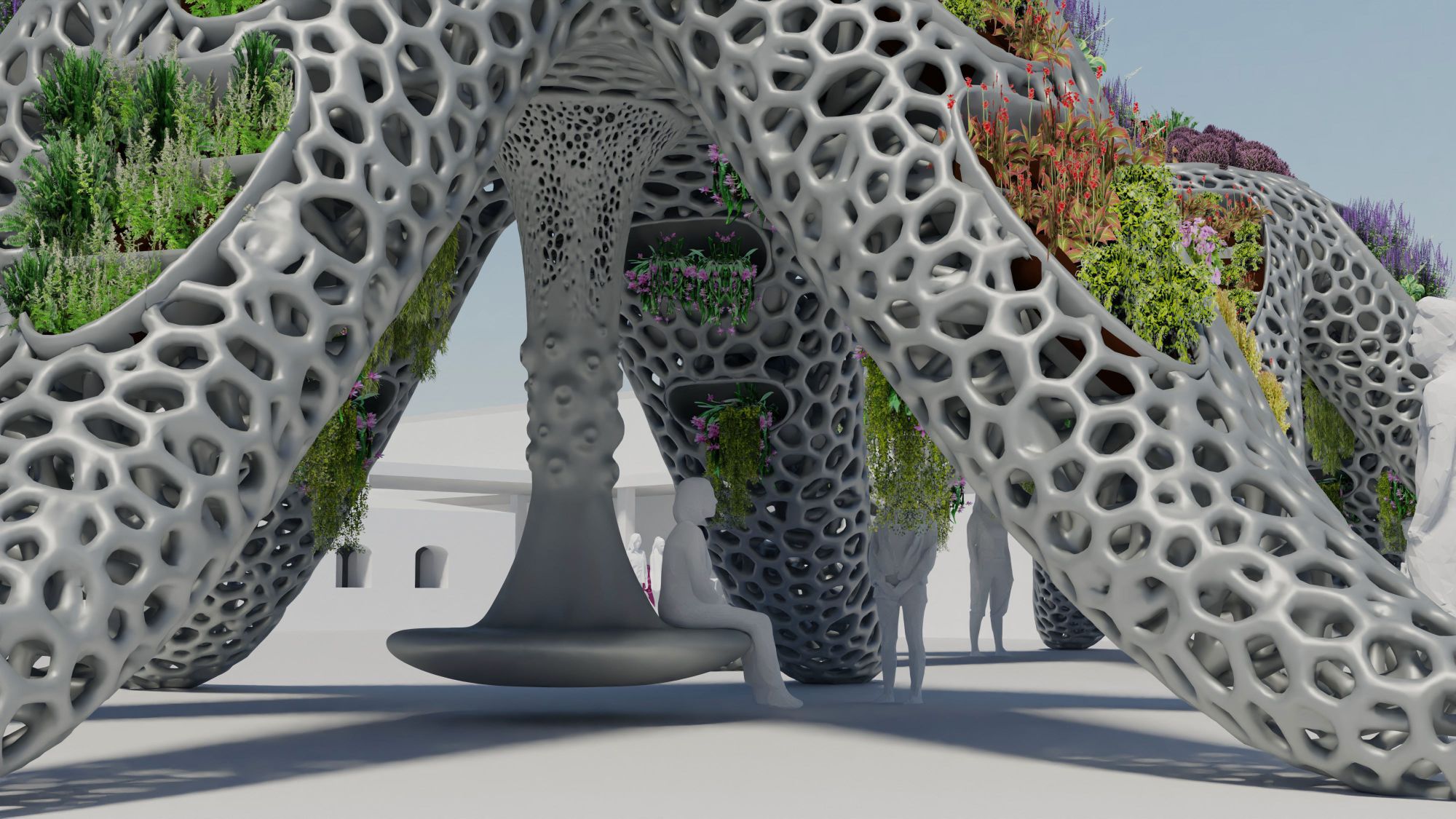
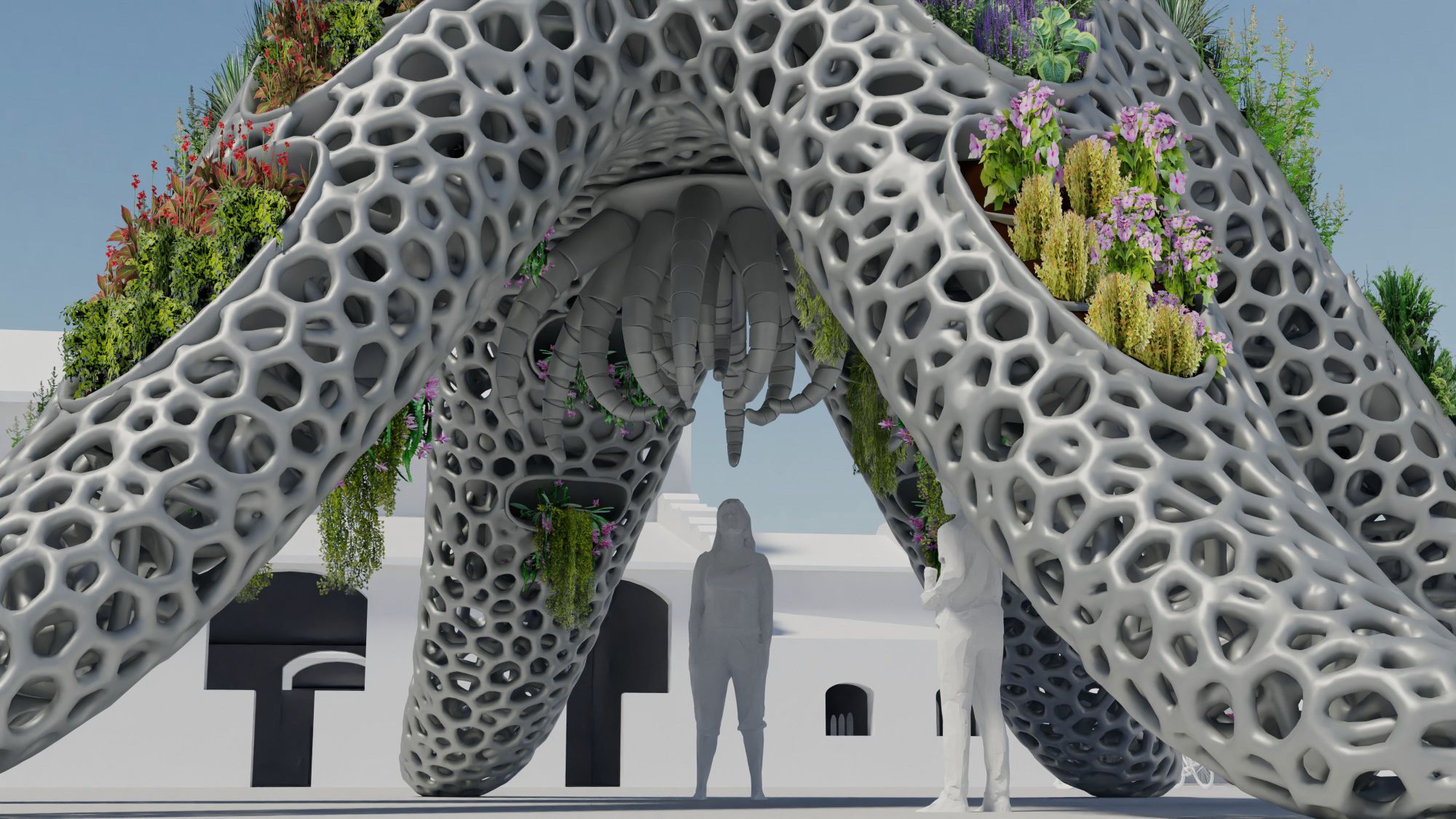
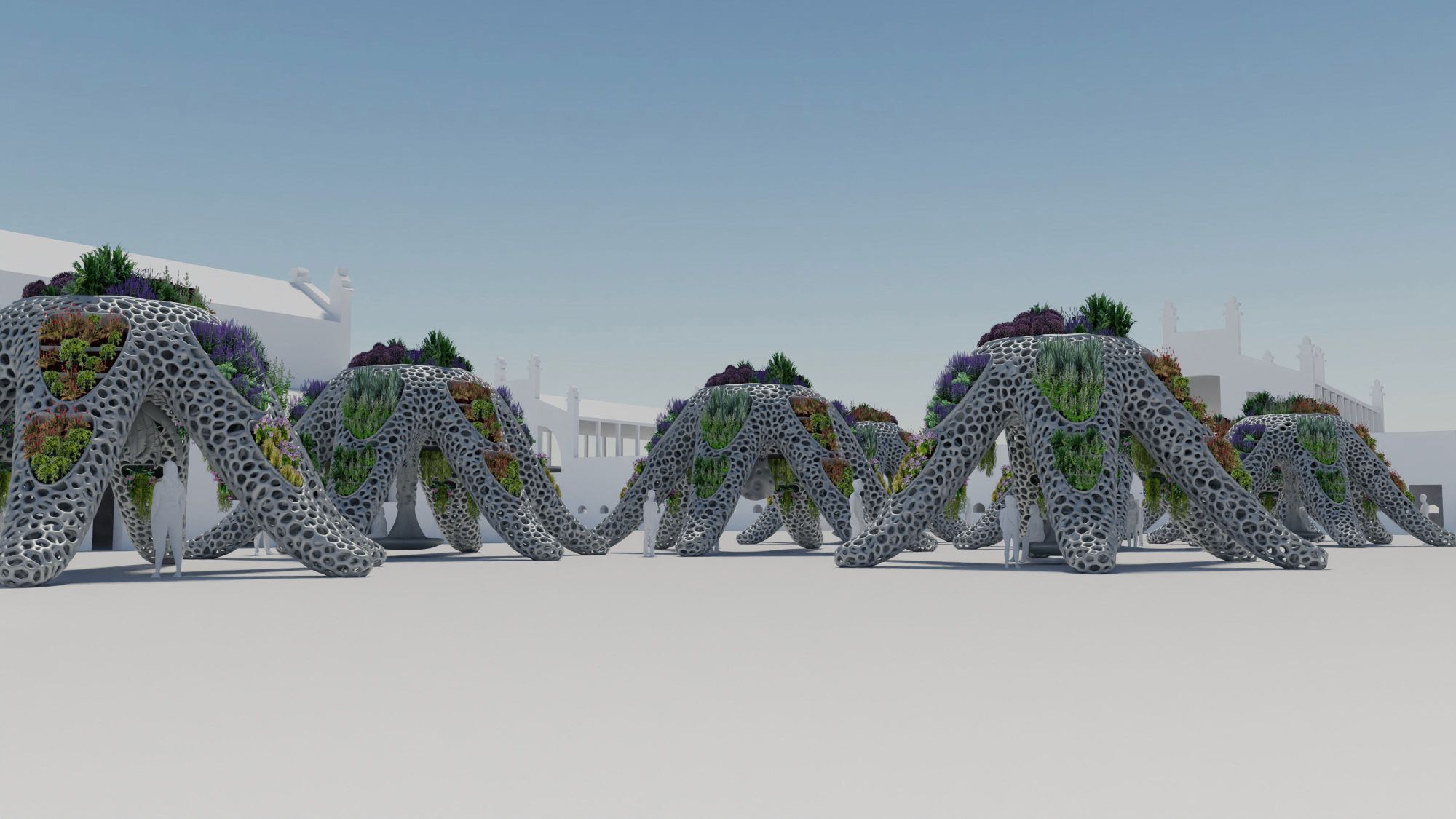
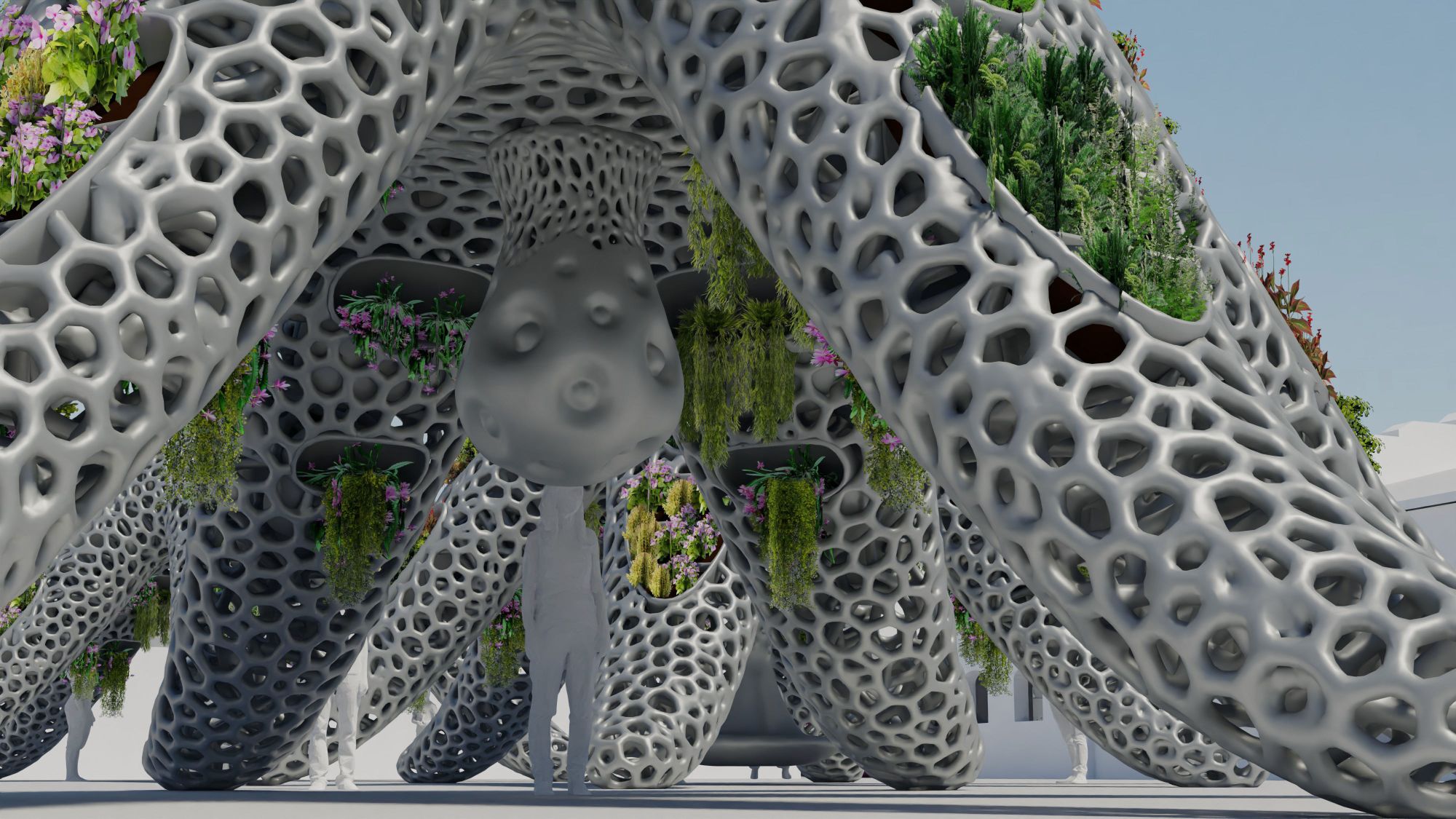
The stars are large-scale modular structures with an organic morphology that allows them to be inhabited by plants both within their interior and across their surface. Their cavities and openings create microhabitats where different plant species, insects, and other organisms can settle, contributing to the formation of a hybrid ecosystem and improving the climatic conditions of the space by generating shade, humidity, and areas for rest.

Each of these structures integrates different modes of interaction with plants, articulated through three types of engagement that are also formally expressed:

Listening
Inside the structure, suspended from its core, a sound device composed of speakers translates the electrical activity of the plants into sound. This makes it possible to listen in real time to variations in their behavior, rendering perceptible a dimension that is normally inaudible.

Haptic perception
At the base, a seating surface integrated into the structure invites visitors to position themselves beneath the star. Through vibrations and micro-movements generated by plant data, the body can directly sense their activity, establishing an intimate and embodied relationship.

Observation of movement
From the interior, soft mechanical systems emerge in the form of tentacles, whose movement is directly linked to data collected from the plants. These “robotic plants” act as visible extensions of their activity, generating a real-time choreography that allows visitors to observe their behavioral patterns.

Mechanical Plants

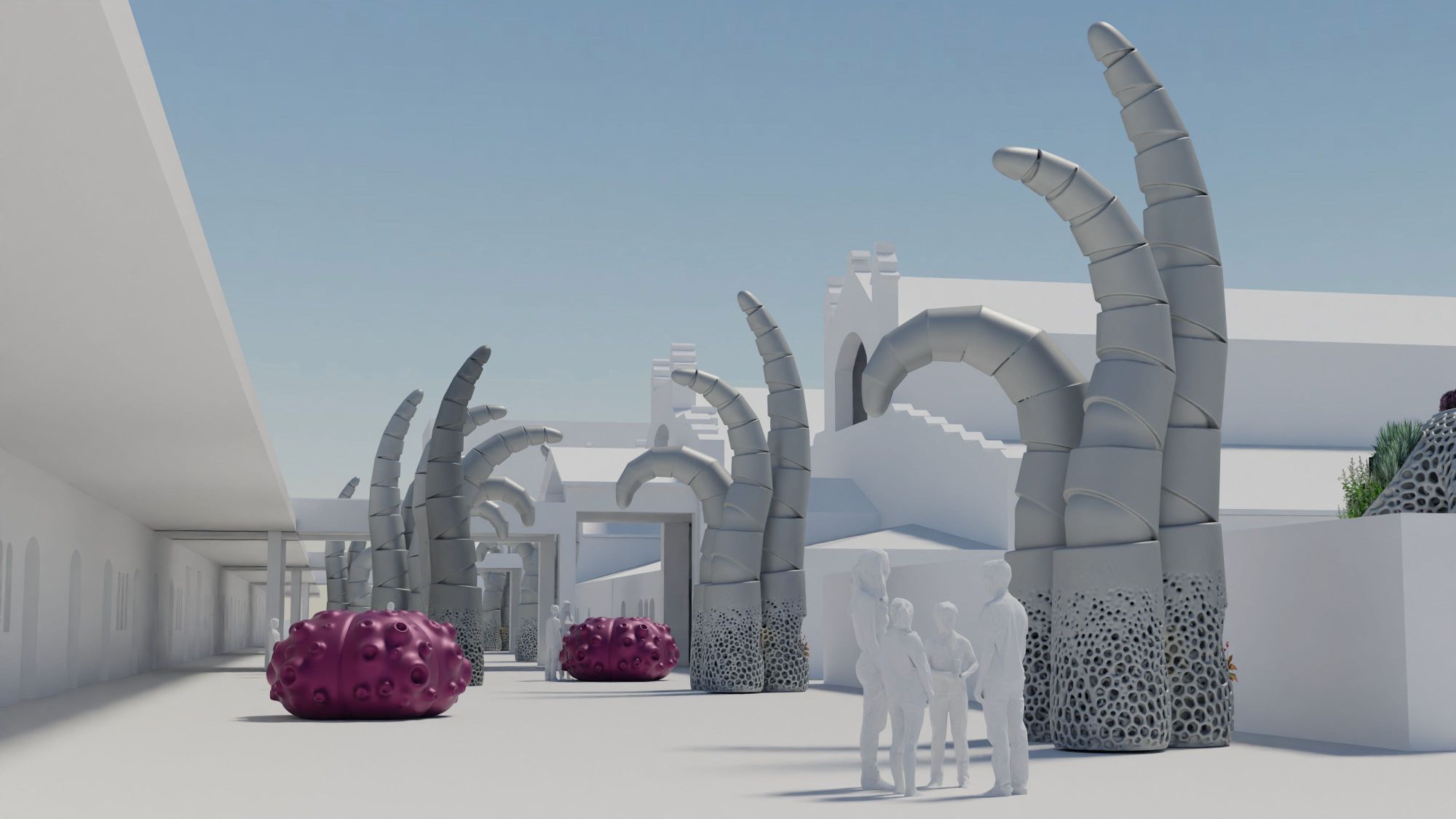
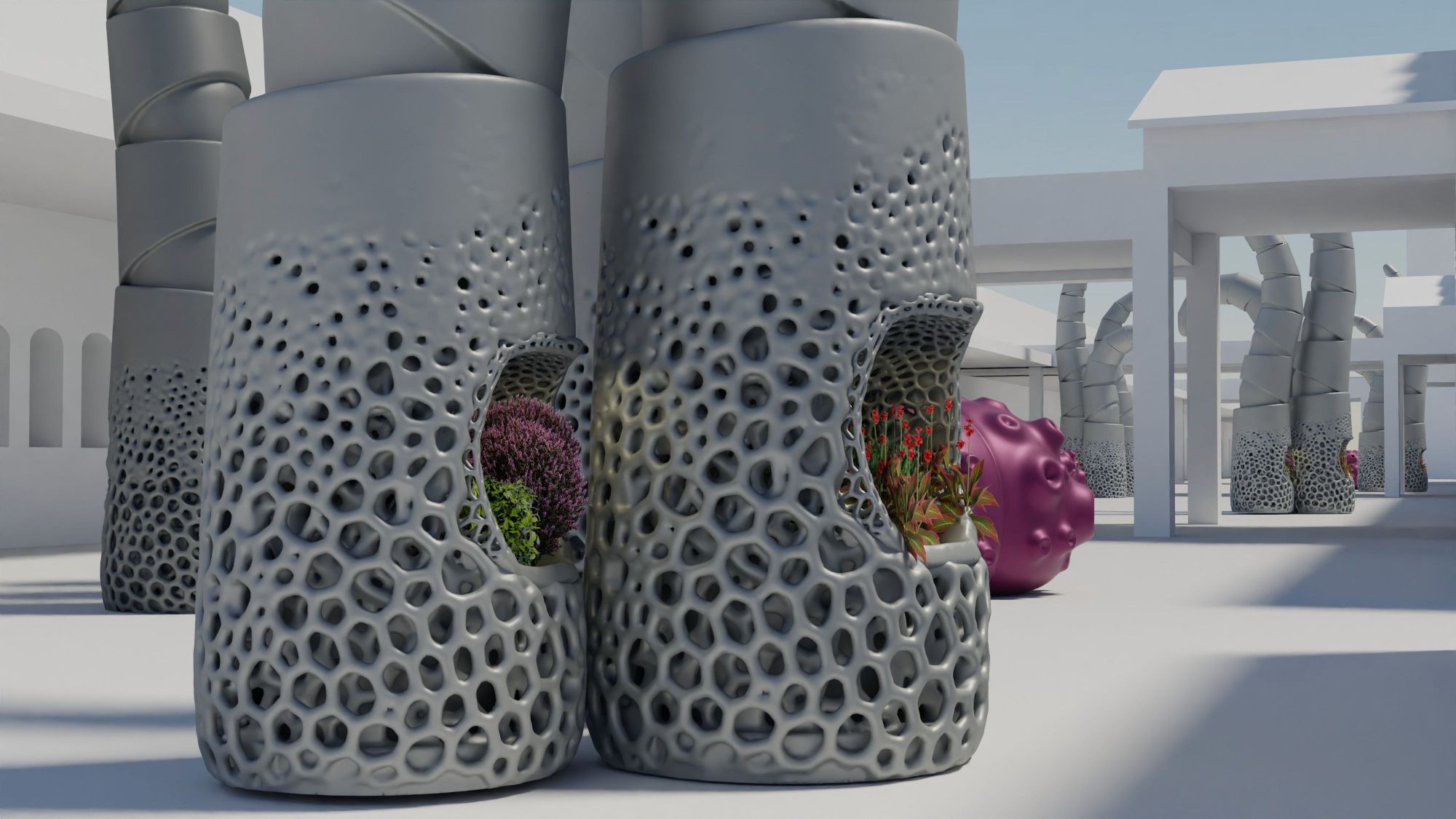
These are articulated systems that emerge from the ground and are distributed throughout the space in small groups, forming hybrid islands where plant organisms and robotic devices coexist. These structures, soft and organic in nature, respond in real time to the electrical activity of the plants to which they are connected.

Their movement—slow, undulating, and continuous—translates internal plant processes that would otherwise remain invisible. Positioned along pathways, these “mechanical plants” introduce a layer of expanded perception into the spatial experience, integrating plant behavior into the everyday environment.

Soft Interfaces

Soft interfaces are sculptures designed to be touched, inhabited, and embraced. Their materiality and scale invite direct bodily interaction. Through vibrations, pressure, and movement generated in real time from plant data, these pieces allow their activity to be felt directly on the skin.
WORK EXHIBITED AT:
Jardín Cyborg. Nave 16, Matadero, Madrid (ES). 14 July - 2 October 2019.


PRESENTATIONS:
The Plants Also Look to the Stars. BoSS Inspiration Session #1, Thyssen-Bornemisza Art Contemporary TBA21 (AT). 16.05.2023.


PUBLICATIONS:
Castellanos, M. (2023). The plants also look to the stars. figurationen: gender literatur kultur, 24(1), 119–134. https://doi.org/10.7788/figu.2023.24.1.119
← Previous
Beyond Human Perception
Next →
Open Environmental Kit